Sunday, November 30, 2014

Thanksgiving Loam


                                     “Loam can be topsoil, but not all topsoil is loam. 
                                                           Topsoil is about location. 
                                                                       Loam is about composition.”   
                                                                                                                   --Me


Teenagers are stupid. I don’t know why they get cursed with both angsty-hormones and incomplete knowledge. 

My particular brand of white, teenage, angst developed around the general concerns in the air. The System, The Man (his evil boss, The White Man), and identity categories. 


I spent my angsty-years in a small town bordering an Indian Reservation. I didn’t have a lot of friends in High School (from the town, the Rez, or otherwise).  I didn’t know much of my surroundings. It took me thirteen years post-High School to ever actually go to the Rez.


I do remember I-81 being shut down, a building or two burning down, the ever-changing graffiti on the billboard, learning about AIM during gym class. I saw these things. 


I like to think that I would have automatically known that the blue guys in “Avatar,” and the mud people in “The Lord of HE WENT TO JARED!” movies rely on regressive native stereotypes. 


Or that I would have watched things in Ferguson with the same heart.

I like to hope I would have been smart enough as a teenager to figure out the messed-up-ness of Columbus Day, no matter where I was living. But I doubt it. Columbus Day hurts my heart and my head (in that order).


Thanksgiving, alternatively, hurts my head first, then my heart. I love that the Thanksgiving story of first contact is about helping immigrants, and feeding them when they needed help. I hate that the Thanksgiving story of first contact has highly limited contemporary application.

I love Love LOVE a secular holiday set aside for being thankful and grateful. I hate Hate HATE that it exists to revise the myth of this land is your land, this land is my land.


For a blog about Soil, I have to tell my story about Land.  It is all I can do to not make a Dawes Act piñata, or a Manifest Destiny punching bag. Bite the curb, Andrew Jackson G-I-Joe. 

In a blog post for Thanksgiving, I have to give thanks for everything I learned in that land. I know enough to know that clichéd trope #1 (as explained by post-colonial theory) happens when; “white people credit exoticized or native areas for self-discovery.” Yes, that I what I'm doing here. And still, anything less would be vulgar.  


I am so thankful that I lived where I did, because my particular patina of angst still remains. I never felt like part of the place there. I rarely feel like part of a place, no matter where I’ve been. Franz Fanon, Andurhati Roy and Ward Churchill explain this in ways I find more accurate. 

Only as an adult do I have the awareness to understand that I wasn’t the only one that felt that way. That so many still do. Teenage hormones aren’t the cause. Nothing about being human is simple. 


I’m thankful for what I learned because of the land I lived on. I’m grateful to be less stupid. Thank you to everyone (my parents included) that put up with me as a teenager. Now let’s all hold our chins up, set the gloves down, and go read some Mary Brave Bird.

Happy Thanksgiving.


The Top 5 Books I’m thinking about this week:
5. Sherman Alexie’s Indian Killer
4. Leslie Marmon Silko’s Ceremony
3. Gerald Vizenor’s Bearheart
2. Leanne Howe’s Shell Shaker
1. Gordon Henry’s  The Light People


Sunday, November 23, 2014

Dirty Jokes

Soon I’m heading off to the American Humor Studies Association conference. Hello New Orleans, I will eat my way through you like a mouse in a baguette! I’m presenting a paper on Stand-up Comedy post- 9/11. (I promise that one of these days I will devote a blog post specifically to what I actually do.)


We all know what dirty jokes are. They are the ones that you don’t; tell your mother (hi Mom!), or post on social media where your supervisor might see them (good evening Professor Wilder, and anyone that will make future decisions about my professional life!).

Like this one:

                Want to hear a dirty joke?

                                John fell in the dirt.

                Want to hear a clean joke?

                                John took a bath with bubbles.

                Want to hear a dirty joke?

                                Bubbles is a hooker.

The overarching theory of comedy for at least a century is the asymmetry theory. From Joseph Boskin’s book, this states that humor results from the resolution of two asymmetrical meanings.

 In the case above, asymmetries are between; dirt-as-in-soiled and dirt-as-in-illicit, bubbles-as-soapy-things and bubbles-as-a-sex-worker, innocence and NSFW-content. We could go on.

In The Humor Code, the authors explain another emerging theory of humor—a theory of benign violation. This explains that humor happens when transgressions are made safe. They use the example of Sarah Silverman being able to get away with incest jokes because she’s just so darn cute. This is also how bigots often justify hate-speak. They say, “Oh lighten up, it’s just a joke!”
 

In the dirty Bubbles joke, the transgression is in being with a hooker, and it’s made acceptable by the context of an innocent bubble bath. Another transgression is that the jokes moves back and forth between “appropriate” and “inappropriate” rhetoric.

Consider the next example:

                What do you call a chicken that crossed the road, rolled in dirt, and came back?

                                A dirty, double-crosser.

Sure, it’s a groaner. But it also shows that the theory of acceptable-transgressions need not only apply to transgressive—or dirty—jokes. The chicken joke works because it transgresses from the standard form of “why did the chicken cross the road?” jokes. It’s made acceptable through the logic of puns.
 

And for a final joke:

                Why was the compost upset?

                                Everyone treated her like dirt!

It is transgressive to anthropomorphize compost. To treat a person-like thing “like dirt” relies on the idiom of “treating someone like dirt” equaling “treat someone poorly.” It’s made acceptable because compost doesn’t really have feelings (even if a previous post might suggest otherwise:

As both a humor of soil geek, this is funny to me, because we would NEVER treat compost the way we would treat dirt! Compost is special, and it keeps dirt happy and healthy! We love you compost, we would never treat you that way…..

The joke makes me sad, too.  I envision a pile of compost with big Miss Piggy fake-eyelashes and big, crocodile tears. Our culture does treat dirt like dirt. We hardly know what compost is! We overuse and abuse dirt. We dump crap in it that will never ever decompose or go away. 

I wonder, how does the form of transgressive humor help us think through our own transgressive behaviors? Is the idea of making-transgression-acceptable right for a culture that is largely okay with ecological transgressions? I have no good answer. Maybe I’ll learn it all in New Orleans.
 

In the meantime, this is one of the comedians I’ll be discussing at the conference:
Maz Jabroni:


Sunday, November 16, 2014

Dormant Dirt

              “Suspend your fear of dirt and all those things we can’t see without our eyes a minute”

                                                                        Maria Rodale, Organic Manifesto
 

Long ago, and in a place very far from here, there lived a young couple. They were both tremendously poor, and they—or rather, one of them was pregnant. She had cravings, as pregnant women reportedly do. But not cravings of pickles and ice cream.

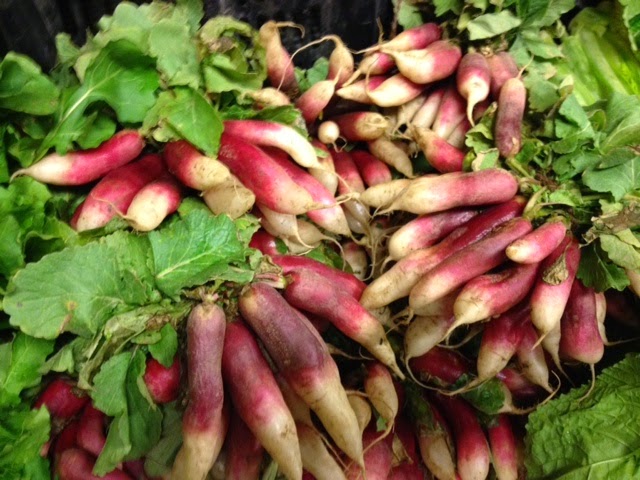
With the hunger of a thousand mouths, she craved radishes. The only place that was on the bus line, open at that time, and sure to have radishes, was Whole Foods. And their radishes were too expensive.  
 

“You know,” she spat, “you sound just like one of those entitled d-bags that would rather save for an xbox than buy real food. Just like Maria Rodale writes in The Organic Manifesto, ‘Sometimes I think the people who complain about Whole Foods don’t remember what it was life before Whole Foods’!!!! That’s on page 129, you poor fool.”

So, out he went for organic, local, non GMO, hormone-free, grass fed, free range, happy radishes. He ruminates about the economy, his inability to provide properly, the state of agriculture in America, and other sad things.
 

He finds himself at his favorite spot to have a wander and a think--the community garden in the good part of town. They don’t have a membership, they think they could not afford it. His armchair-Marxism stirs inside his red red blood. Community Gardens for the Community!

Guided by the light of his refurbished iphone, he weaves through the carefully tended allotments. He crunches through kale and kohlrabi, and clomps through cabbage and collards. At last! A patch of pert, green, prickly pony tails spilled from tiny pink scalps.

Gritty and chilled, he wanders home with full arms. All aglow, his wife alternates between crunching on the red gems and kissing his frozen fingers. They lay in bed happy and tingly from the bounty.

They feast on radish greens with gas station bacon and syrupy balsamic, mini-radish latkes, mayo-slathered radishes, tuna-radish salad, radish puree on cornmeal mush, radish greens gratin, and boxed wine poached radishes. This last one is horrid, but she loves the taste without the threat of alcohol.
 

It is a radish wonderland. Well, until it is not. One night in the midst of his gleaning, a bony hand digs into the scruff of his neck and grinds his face into the mud. Through dirty, broken teeth, he appeals to logos, pathos and ethos. He explains himself to yellowed eyes shining angry in the dark.

We know how the story ends. The master of the bony hand and angry eyes promised the poor man all the radishes he wanted for the duration of the pregnancy—with the caveat that one day She would come to him with a demand that he would not refuse.


The child is born, and named “Rapunzel,” a take on the Latin, “Raphanus sativus,” aka radish. We know she is taken, kept in a tower, something about Stevie Nicks-long hair, and a chivalric rescue. None of that is the point.
 

The moral of the story comes at the beginning. Be careful about your commitments. Once you start something, it must be finished. Remember that which has gone dormant. Remember this as we head into winter.

It’s a story I think about as I pull radishes from my front porch pots, and as I shirk my weekly blog commitment. Writers know the feel of bony hands on our scruff. We know the feeling of mud in our mouths. Forgive us our lapses and, for good or bad, in the presence of dormant things.


For more on the origins of the Rapunzel story:

The Organic Manifesto:

Sunday, September 14, 2014

Dirty Books


This week marks a momentous moment in the journey of my year. This week I began Haruki Murakami’s Colorless Tsukuru Tazaki and His Years of Pilgrimage. This book is the 100th book that I’ve read in 2014. Yes, I am a word nerd. Yes, there are disclaimers to this measurement. I will list them now:

First, I have “read” more than 100 books since January 1st, 2014. But I consider these 100 to be “pleasure reading” rather than reading for work, albeit those lines blur more than Robin Thicke blurs grammatical rules. Secondly, I count audiobooks as Reading. If you have a problem with that we can deal with you later.

From this centipedial composite of stories, I have picked what I consider to be the Top Ten Dirtiest Books. In no particular order, I will list them now…


Darcy’s top ten dirty books from her first 100 books of 2014:
10. The Poisonwood Bible. Barbara Kingsolver
9. The Emperor of All Maladies: a Biography of Cancer. Siddhartha Mukherjee
8. Lean in. Sheryl Sandburg
7. Room. Emma Donoghue
6. What Maisie Knew. Henry James.
5. The Help. Kathryn Stockett
4. Hyperbole and a Half. Allie Brosh
3. Summer House with Swimming Pool. Herman Koch
2. Notes of a Native Son. James Baldwin
1. Fun Home. Alison Bechdel

By dirty books I mean books that, in one way or another, bring me back to my originary and beloved definition of the difference between “soil” and “dirt.” Soil is when it’s outside, dirt is when it’s inside.
These Dirty Books deal with the beauty, paradoxes and traumas (mostly traumas) that result from bringing something (or someone) from the periphery to the center.

For The Help it is that famous special pie. That pie that shouldna never ever been put in one’s mouth. That pie of protest and revenge for being told ‘You don’t belong inside. You are dirty.’ Or for The Emperor of All Maladies, it is writing the biography of the thing, the terrible awful, of when bodies go rogue and make inside what Should Not Be. 

Lean In tells women to Be The Dirt, put yourself at the center of the boardroom where you’ve been told you don’t belong. Sure, there might be consequences, but you can negotiate your way out of being untouchable. Just make sure you have a supportive partner, and have a career in corporate America—not on the bottom two thirds of the employment ladder…. Notes of A Native Son would put Lean In on the same shelf with Uncle Tom’s Cabin. I think I would literally do that had I not borrowed Lean In from the library…..

The Poisonwood Bible has the dirt of the destructive and abusive colonial projects, and those sins of the fathers dirty a family. Fun Home gets to the core of the family dirt—when your family treats you like dirt, the thing that doesn’t belong, the thing that needs to be cleaned. What Maisie Knew shows us when a family treats a child like a dirty bomb. Hyperbole and a Half shows us treating The Self like that. 

Summer House With Swimming Pool and Room are different. They tackle containment of that which threatens to return to the periphery, in one way or another, for better or worse.

Sigh. Do you have any idea how hard it is to have good ethics and avoid spoilers!?! There’s so much more to say about all of these books. Read them all! Even Lean In!

There are many “obvious” choices that I kept off the top ten list. By obvious choices, I mean books dripping with soil, like: Kimball’s The Dirty Life, Mud Season, Second Nature, Dissident Gardens,…. Or the other side of the dirty, dripping coin: Savage Love, Sex Tips for Straight Women from a Gay Man, My Horizontal Life, The Abstinence Teacher…..

Point is, writing that celebrates interfaces is writing I want to celebrate. Furthermore, I want to celebrate reading a crap load of awesome books. 

Here's #101:

For a complete list of what I’ve read this year, check out my board on pinterest. I won't remember unless I pin them!

I got 9/10 one of these books from my library. Support Libraries, whether they catalog seeds or books!


Sunday, September 7, 2014

Dirty Feet


This weekend was the Washington County Cheese Tour. It is my FAVORITE weekend of the year! Better than Christmas. Five of the awesomest cheesemaking farms along the NY/VT border open their gates to the public. And O Lord. The cheese. The Goats. The Everything. 

First on the stop, Sweet Spring Farm, can only be described as Goat Disney Land. Walking up you see the stinky billy goats on your left, and then all the teeny, tiny, sweet as sugar kids. My knee got tongued by the most adorable young goat. (Shout out to Lush—bathe in Marizbain bubble bar, baby goats will lick your knee).
Kisses were given to the Mom-goats, cheeses were tasted (and purchased), the cave was peeped upon, and we trekked back out to the car. Feet were checked for goat droppings before entering the very clean vehicle.


There are middle things. Then the last stop, 3 Corner Hill Farm. If Sweet Hill Farm was Goat Disney Land, 3 Corner Hill Farm is Sheep and Lamb Disney Land. Only you have to wash your shoes before you enter. Meaning, one could unknowingly be bringing horrible parasites, diseases or other very bad things from Goat Disney Land to Sheep Disney Land. Not cool, man. Not cool. 

My only real associations with the importance of shoe-foot-washing comes from The Odyssey, and Mary Magdalene.

The Odyssey. This is my truncated version of what matters: In the Odyssey, the hero returns home in disguise, and is found out when Eurycleia washes his feet. Foot washing equals sign of respect, means of uncovering the truth and how all will be righted in Ithaca.

Mary Magdalene. Maundry, the Judeo-Christian practice of foot-washing, is a practice of blessing. The Mary Magdalene of art history class washed Jesus’ feet with her tears and her hair after he cured her of evil spirits. Foot washing equals a very serious thank you note. 

Whatever god there may be, strike me dead if you hear this rhetorical question in your head in Sarah Jessica Parker’s voice a la “Sex In The City laptop musings.” I can’t help but wonder if the whole practice of foot washing, from back in the day, wasn’t only religious, but a form of biosecurity?


Humans before *right now* might not have fully grasped the importance of hygiene and whatnot. But did farmers know that it was important to keep dangerous parasites, weed seeds and other unwanteds out of their soil? 

Biosecurity takes many forms. Washing your shoes before entering an organic farm helps protect the animals from parasites and diseases that you may have, unknowingly, been carrying around in the treads of your Steve Maddens, Keens, or otherwise sensible footwear. 


Might early representations of foot washing not only have been about blessing the person getting their mini-pedicures, but also about blessing the land? These are questions I don’t know the answer to. Nevertheless, I wonder if something about the horticultural role of foot washing in earlier times was lost along with other bits of wisdom.


(this is me cheating on my dog with a sweet goat.)

Sweet Spring Farm:
 http://www.sweetspringfarm.com/

3 Corner Farm:
http://www.dairysheepfarm.com/

Lush Marzibain:
http://allthingslushuk.blogspot.com/2014/07/review-marzibain-bubble-bar.html

Monday, August 25, 2014

Semiotics of Soil


 Displaying photo.JPG

A week ago I went to hear Dan Barber give a talk with Elizabeth Kolbert about his book, The Third Plate. Some of you may remember my brief mention of him in my notapoem, “Notes On A Poem About Compost.”

Toward the end of the event, Barber answered seven questions collected from the audience on index cards. Highlights include: MY QUESTION WAS THE SECOND CARD PICKED!

(Or another folk—or folks—had the same question. Totally possible. Not as awesome-feeling. That question, “how do you define “local”? deserves a post, err, dissertation all its own.)  

Another question got to the marrow of what would be the third plate of the Berkshires. To explain in one sentence or less what Barber takes a whole book to investigate, the “Third Plate,” explores the “local” equivalent of terroir that we could hope to see in 2050.
Barber’s answer, “Rotation Risotto,” made me hungry. He gave a waiter’s explanation of Rotation Risotto; “it’s nose to tail eating of the whole farm” The dish include the crops needed for crop rotation, or companion planting, on Blue Hill Farm.   

In the Epilogue of his book, Barber describes this dish as the second course of an entire menu of “whole farm cooking." He also mentions “single udder butter,” which I think I kinda want to eat all day, every day…… Christmas is coming. Please take me to Blue Hill Farm!


The trick to the flavor of the milk used for butter, the epilogue explains, is most certainly and obviously the cow’s diet. Grazing on plants that grow in nutrient-rich soil determines the flavor of the milk, and therefore butter, that is the kind of dreamy butter that I’m dreaming of now.

Barber’s epilogue explains how taste works for that butter, that 'the trick is to learn the language of the soil.’

All you need to know about language: language generally refers to the learning and use of communication systems, their rules, and what those rule can produce. Semiotics is the relating of signs with meanings. All languages rely on this.

The semiotics of soil are fairly clear. Take the dust bowl of the dirty 30’s. The application of European agricultural practices to land that was, well, in America, led to a dusty shit storm. We know Dorthea Lange’s powerful photographs about this:

The dirty 30’s forced us to relate the signs (dust storms) with meanings (we’re in deep, dusty trouble, we need to change our practices). The semiotics there are clear. There was a big breakdown in the communication system. We didn’t do language right in that situation.

Take a different example of a semiotic-soil-situation; the companion planting process known as the three sisters. The three sisters, corn (maize), beans, and squash, feed the soil and protect each other in specific ways. 
https://encrypted-tbn0.gstatic.com/images?q=tbn:ANd9GcRRUx55gK8akR6VIkZBw21H0NY-PIk5EVo99gdlb7ngS85eGtdlUeg2-DTM

Beans climb the corn. Beans feed the soil nitrogen, which the corn gobbles right up. Squash acts as a weed-blocker, like a mulch. The three crops together also fulfill a wide range of dietary needs. How awesome is that!

The semiotics in the example of the three sisters is pretty clear, too. The signs are that these crops help each other, and together provide a good nutritional assemblage. The meanings are even more lucid. This works, this is symbiotic and smart.  

Granted, thinking about “the language” of soil is an exercise in metaphor. But it is an important exercise. “Learning the language of soil” is what will teach us to agricultural practices that we need in order to feed the world’s population. And it will keep that beautiful single utter butter coming!*

*Dan Barber, if you’re reading this, do you ship your butter to Albany?....   


Displaying photo.JPG

Ceci n'est pas une puppy. (final pun. apologies to the semiotic godfather, Magritte.)

Blue Hill at Stone Barns:
http://www.bluehillfarm.com/food/blue-hill-stone-barns

semiotics for beginners:
 http://visual-memory.co.uk/daniel/Documents/S4B/sem01.html

Monday, August 18, 2014

Soil vs. Sadness


No matter which way you cut it, this week has been a monster with particularly goopey eyes. Robin Williams, Lauren Bacall, the frustration in just hearing the words Ferguson, ISIS, or Gaza…. As one friend put it, “this [crap] makes you rethink a disbelief in cosmic convergence.”

I have two words that don’t pretend to solve any collective sadness, but two words that, nonetheless, are worth considering: Microbacterium vaccae.

I’ll save you the trouble of going to Wikipedia.
Mycobacterium vaccae is a nonpathogenic[1] species of the Mycobacteriaceae family of bacteria that lives naturally in soil. Its name originates from the Latin word, vacca (cow), since it was first cultured from cow dung in Austria.[2] Research areas being pursued with regard to killed Mycobacterium vaccae vaccine include immunotherapy for allergic asthma, cancer, depression, leprosy,[3] psoriasis, dermatitis, eczema and tuberculosis.[3]

This bacteria is the stuff that *may* up serotonin production.* Serotonin, as we all know and love, is the happy neurotransmitter. This isn't bull shit (har har). We need it.

Maybe getting a little dirtier would be a good thing.

Maybe there’s a reason why mud baths are so expensive, and (supposedly) so awesome. I don’t know of what I speak. I’ve never had an expensive mud bath. Should start a kickstarter fund to go get a mud bath at a proper spa.  


Mycobacterium vaccae raises questions about a lot of things. About pica (dirt eating). About eating unwashed things from my garden. (Think tomatoes, not old socks.) I know I’m likely to eat a bit of dirt while I’m out there. Don’t judge me.

It also raises other questions. About what exactly happens when we get our hands dirty in the garden. About “kids these days” playing their “dang video games” instead of “going out and getting muddy.” About even how dang video games can send us out to go get muddy.


The dang video game that I love the best is SuperBetter. It’s a game brought to us by the genius, Jane McGonigal (author of Reality Is Broken).You can play alone, but it is better when you play with others. You do things in real life (“power-ups”) that will give you points in the game. My favorite ones send me outside to dig in the dirt. 

Check it out. Heck, send me a note and I’ll play with you.

We all need each other right now, and always. We need a relationship with soil, now and always.

I’m not disconnected from reality. Neither rubbing soil all over one’s self nor eating mud-pies are medically suggested cures for depression. Nor will they cause a permanent cease-fire in Gaza. Or Missouri. Furthermore, I cut and pasted that Science from Wikipedia—that isn’t gospel.

But if you want to dig deeper into the science behind mycobacterium vaccae, do it. Next time you feel like crap and feel the temptation to lose yourself in cat videos on the internet, try something else first. See what happens if you go in your back yard and dig for a while instead. Bring a friend. Tell them that you love them.


(My dirty dog.)


In case you don’t feel like reading anymore, here’s a video of Jane McGonigal explaining Super Better:
https://www.ted.com/talks/jane_mcgonigal_the_game_that_can_give_you_10_extra_years_of_life

Super Better:
http://blog.superbetter.com/

Wikipedia:

*This is “may” as in “maybe might.” For the sake of being sensible, know that I am not a medical doctor and am not offering medical advice.